Climate
Trid’s distance from Ammonkis allows for five distinct climate bands, while its axial tilt provides seasonal variation by latitude. Most societies are agrarian, and the climatic impact on what can be grown and how quickly is the primary factor in population migrations and density.
Five climate bands, each 18 degrees north-to-south, characterise the environmental conditions between the equator and each of Trid’s poles.
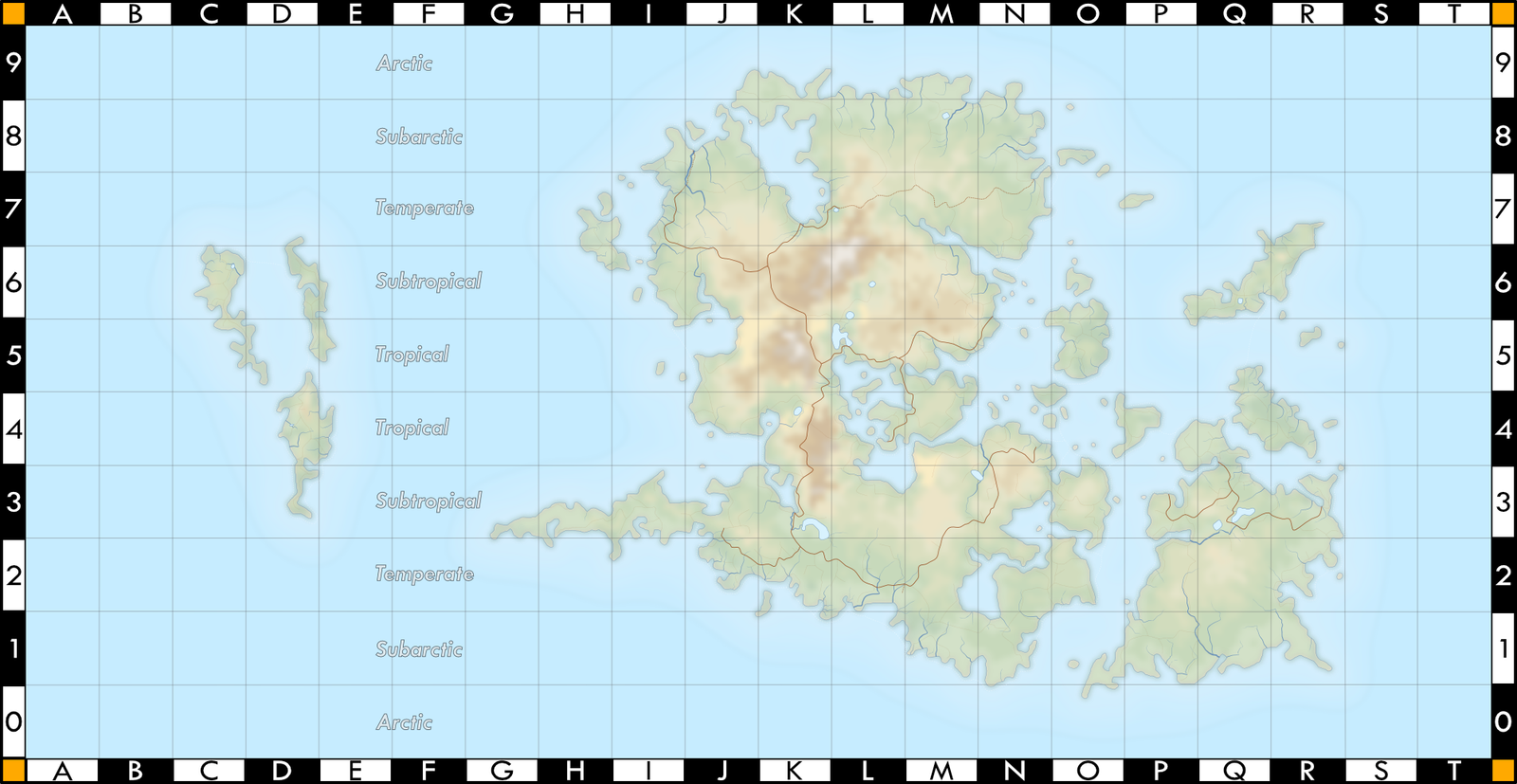
Tropical: The equator straddles Trid’s tropical belt. Periods of daylight and night are roughly equal. Areas within this band are hot, and where rain falls, winter is characterised by violent rainstorms and hurricanes. Tropical forests are known as jungles, and grass- and scrublands occur where rainfall is diminished, yielding ultimately to desert in the most arid regions.
Sub-tropical: The sub-tropical band hosts long dry summers and short rainy winters. Lush forests and grasslands exist where rainfall is high, and seas are warm throughout the year. For each sub-tropical belt, the border closest to the equator marks the extremes of Trid’s northern and southern axial tilt, referred to as the Northern and Southern Tropics, respectively.
Temperate: In the temperate belts, temperatures are moderate and seasons are distinct, which leads to easily predicted periods of growing and harvesting. All manner of vegetation covers the ground; large standing forests, vast grasslands, pains, and steppe are common.
Subarctic: The sub-arctic bands are quite cold, and periods of daylight and night are skewed by the axial tilt of the planet. Taiga is common and vegetation is sparse, though seasonal scrub and evergreen dominate when the temperature is high enough to melt the permafrost. Deep snow hampers overland travel, while icebergs and ice floes are dangerous obstacles on lakes, rivers, and seas.
Arctic: The arctic bands surround Trid’s north and south poles. Temperatures rarely rise above freezing and there is no vegetation. Instead, both land and sea are covered with ice and snow, and depending on the time of year, there are days when the sun never rises or never sets.