An Overview of Trid
Trid is an old world, scarred, healed, and scarred again through the rise and fall of empires. First were the Builders of the Before Times, whose disappearance allowed the reptile Ophidians to dominate the Dim Ages that followed. The elves, allied with men, toppled the Ophidian Empire to usher in the Age of Fable, defined by the Ardic Republic that spanned over half the Continent.
The present Age of History began some five centuries ago, when the Divine Awakening enabled humans to access divine magic. The rise of the clerical class countered the elves’ arcane edge, initiating the slow decline of the Republic to its recent fall. The elves created power vacuums as they scattered, and the new wilderness is held variously by self-styled kings, monied nobles, warlords, religious orders, adventurers, wildermen, humanoids, and monsters.
All strive to create order and safety for themselves, and perhaps others depending on whether they see power as a means or an end. The Old Ways linger in the wilds, where the Local Gods guide and protect their peoples. In Settled lands, the New Gods hold sway, and their clerics can rival the scope of kings. In between are power brokers of every stripe, seeking to advance their own agendas amid the ruins of three dead empires, each rife with secrets, treasure, and magic.
The World
Trid is the second planet of the Ammonkis System and with a circumference of roughly 18,000 miles is approximately three-quarters the size of Earth. The planet holds two moons in orbit: Lyolm, a verdant orb whose phases follow a 30-day cycle; and Opho, a radiant, hurtling speck of light whose unpredictable appearance disrupts Trid’s magical field via a phenomenon known as the Ardic Curse.
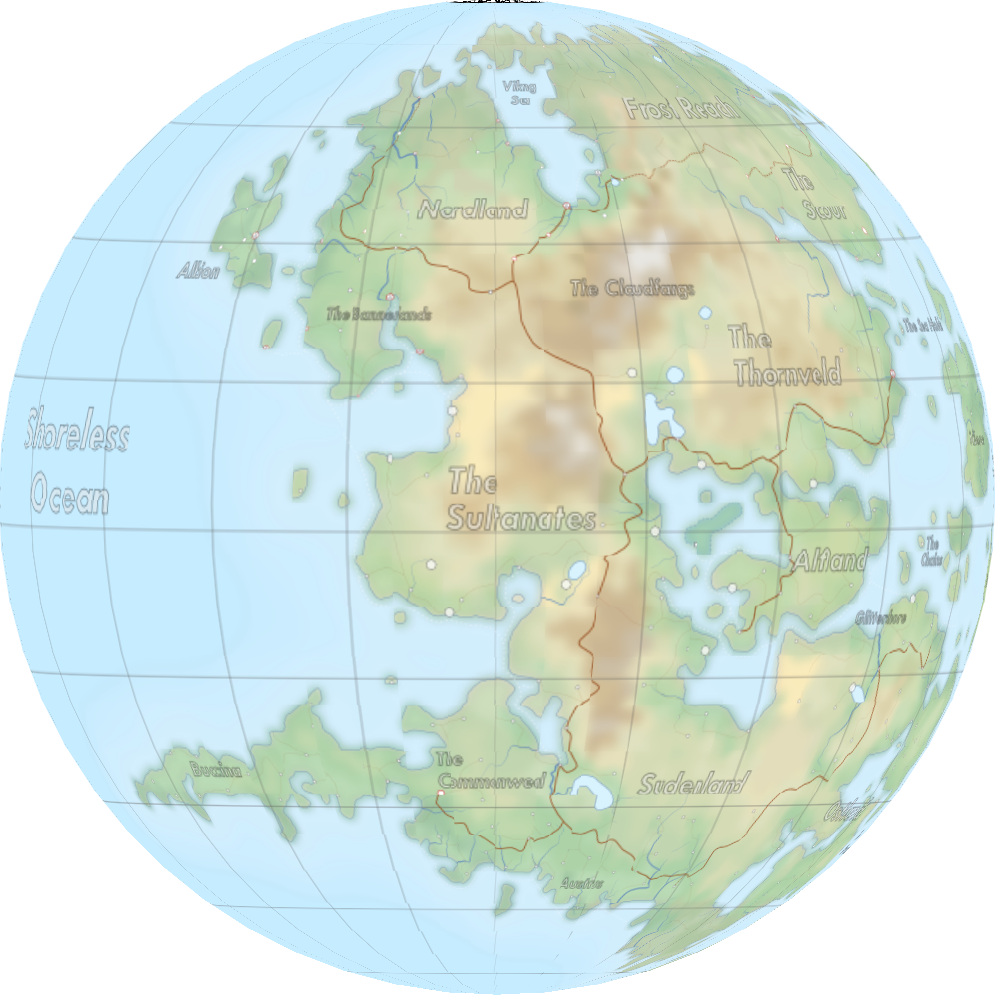
A little less than half of Trid’s surface consists of two major landmasses and a scattering of large islands and archipelagos:
The Continent: Spanning nearly pole-to-pole, the Continent is a Pangean expanse comprising more than three-quarters of the habitable land on Trid and is home to elves and half-elves, dwarfs, halflings, and humans. Beyond settled borders, the Continent’s wilderness is haven to goblins, orcs, ogres, dragons, giants, and the remnant species of the now-extinct ophidians.
Eremus: A large island south-east of the Continent, Eremus is largely unexplored, though the regions north of the Elven Road have seen occupation by ophidians, elves, and halflings.
The Far Isles: A trio of islands beyond the Shoreless Ocean west of the Continent, the Far Isles are unknown to Continentals, save for cryptic references within the Jade Chronicle and some vague scraps gathered through divination.
The Serpent Sea: The tropical waters east of the Continent contain a sprawl of large islands and smaller archipelagos. The ancient homeland of the now-extinct Ophidian race, the region is dominated today by Segelmen, whose city-states are scattered throughout.
The People
Humans dominate Trid and have migrated to all corners of the Continent. Demihumans include the elves, who occupy stagnant dominions far from humans; the dwarfs, who avoid the surface world; and halflings, who may be found abundantly alongside human communities. Mixed in are warlords, humanoids, and monsters who threaten settled lands from their wilderness enclaves.
Civilised Humans
Civilised human cultures dominate the settled regions of the Continent, particularly those that once belonged to the Ardic Republic. They practice clericalism, having abandoned the Old Ways in favour of the New Gods. Eager to assert their new identities apart from the Ardic Republic, civilised humans are nevertheless the inheritors of the Republic’s roads, ruins, and administrative instincts.
Midlanders: The Twelve MIdlander tribes are spread across the tropics that separate the Continent’s northern cultures from those of the south. The Midlanders are shrewd merchants and the most advanced metallurgists, astronomers, and mathematicians on the Continent.
Ostmen: Disciplined urbanites whose settlements prize order, discipline, and civic hierarchy. Their homeland is divided into six imperial territories where they practice ancestor worship and excel at engineering and military technology. Since the Age of Fable, the Ostmen have isolated themselves from the rest of the Continent, though Traders are permitted to traffic in a carefully metered supply of rare and precious goods from behind the wall.
Sauvon: Of mixed Nordmen and Midlander stock, the Sauvon of the Bannerlands were late members of the Ardic Republic and fully embraced the New Gods following the Divine Awakening. They enjoy brisk trade with the Midlanders and excel at alchemy, though relations with their Nordmen forebears are uneasy.
Segelmen: Coastal navigators, the Segelmen have spread their city states across the islands of The Serpent Sea. They thrive on maritime trade with the Continent, as often pirates as merchants.
Sudemen: Farmers, adventurers, and mercenaries, the Sudemen share cultural traditions, but the collapse of elven rule has left much of the landscape to wilderness dominated by self-styled warlords and petty kings, each with their own ideas of local order.
Wilderman
Wildermen are humans of cultures that resisted Ardic expansion. They live in wilderness and frontier regions, practicing the Old Ways and maintaining deep ties to land and lineage. Their clans vary widely based on their environment and traditions, but all are adept at wilderness survival and know their ancient territory intimately. They respect strength, tradition, and the spirits of place, as represented by their local gods.
Nordmen: The hardy folk of the cold north, known for stonecraft, ironwork, and stoic traditions. They look for guidance among the AEsir, a pantheon of local gods who encourage self-reliance. The kingdoms of Nordland are the most ordered of the “Barbarian North,” while the Jarlefolk of the Frost Reach are as violent and disordered as their land.
Rovers: Nomads of the Scour, the Rovers keep to the steppe, following game herds throughout the year to set up semi-permanent camps. Divided into three distinct (and sometimes-cooperative) tribes, the Rovers venerate the Uliger, a pantheon of local gods who represent elemental forces.
Traders: Itinerant merchants who travel the Continent on the Elven Roads, carrying news, goods, and secrets. Their traditions espouse fellowship, they fight only in self-defence, and they never lie.
Demihumans
Demihuman populations on Trid are in decline and, save for halflings, do not mix with humans. However, what demihumans lack in numbers, they make up for in cultural memory and craftsmanship.
Alfmen: Common to the Glittershore, Alfmen are Trid’s half-elves. At home with neither elves nor humans, they have taken advantage of the Republic’s fall to establish new dominions within the wilds of the Ardic Peninsula.
Dwarfs: Originating in the mountains of the Cloudfangs, dwarfs are subterranean miners, smiths, and artisans seldom seen on the surface. They are known primarily through artefacts recovered from their abandoned halls and are believed to dwell in vast underground cities.
Elves: The Ardic peoples figure prominently in Trid’s history, first by allying with man to eradicate the Ophidians and second by forming the Ardic Republic that spanned over half the Continent. Following the Republic’s fall, elves retreated to found their own dominions—some along the shores surrounding Mare Incantum, but many in far-flung wilderness areas.
Halflings: Adaptable and community-oriented, Trid’s halflings hail from Austrus, but may be encountered all over the Continent, particularly among civilised human cultures where they are creative and savvy entrepreneurs.
Humanoids
Humanoids encompass a wide range of tribal groups often pushed to the margins: goblins, hobgoblins, orcs, ogres, gnolls, and giants. Their societies vary from raiding bands to disciplined war-clans. Those of a more mercenary bent have allied with human power brokers for mutual gain, but most remain locked in cycles of conflict shaped by geography, scarcity, and clan rivalries.
Ophidians
The Ophidians are reptilian peoples whose cultures predate human settlement, and their ruins are found throughout the tropical latitudes. Through their empire was crushed by elves and men at the end of the Dim Ages, remnants of their lineage may be encountered today as lizard men, kobolds, and troglodytes.
The Gods
Religion and worship has evolved along with the Continent’s peoples, all through the ages of Trid. At a high level, there are four models for immortal reverence on the Continent:
Local Gods
These deities are tied to specific regions, peoples, or traditions. Synonymous with the Old Ways, local gods represent the beliefs and priorities of the cultures who acknowledge them, personifying natural forces, base human emotions, and the relationship between the two. Adherents respect the entirety of their local pantheons and appeal to a particular local god as circumstances require. Ritualists interpret the local gods’ will, and the folk magic they wield predates the Divine Awakening. The most prominent pantheons of local gods include:
The AEsir: Warrior-spirits and ancestral powers revered in Nordland and the Frost Reach. They embody determination, courage, and resilience.
The Circle: Represented by the 12 constellations of Trid’s zodiac, the Circle is a pantheon of nine gods and the three demiurges that motivate them: creation, destruction, and transformation. As the Circle wheels across the sky throughout the year, each constellation exerts its influence on Trid in turn, creating a cycle of order, disorder, and balance.
The Fey Court: A shifting assembly of capricious, ancient beings tied to the natural and unseen worlds. Their worship is half reverence, half appeasement.
The Uliger: Elemental spirits honored by the Rovers of the Scour. They govern wind, earth, rivers, and sky, guiding the obedient to survival on the steppe.
The Gods of Trid
Late in the Age of Fable, human ritualists began to worship certain gods of The Circle individually, a practice that lead to the Divine Awakening, during which humans first received divine magic. Clerical orders dedicated to all 12 gods of the Circle — now collectively known as the Gods of Trid — soon followed, wielding clerical spells to reshape human culture across the Continent. The twelve Gods of Trid are:
| God | Influence | Alignment | Notes |
|---|---|---|---|
| Broon | Creation | L | Demi-urge |
| Apollo | Wisdom, discipline | L | Constellation: |
| Dionysus | Love, desire | C | Constellation: |
| Cygnus | Self-control | N | Constellation: |
| The Necromancer | Destruction | C | Demi-urge |
| Lamneth | Empathy, community | L | Constellation: |
| Syrinx | Secrets, forbidden knowledge | C | Constellation: |
| Rocinante | Self-determination | N | Constellation: |
| Marathon | Transformation | N | Demi-urge |
| Godswon | Duty, justice | L | Constellation: |
| Tybor | Fury | C | Constellation: |
| Master Yow | Self-sufficiency | N | Constellation: |
The Lawful Faith
In the 3rd century, the Midlander dervishes of Bar-Shet established a fighting order dedicated to Godswon’s consort, Tish, referred to as the Lady of Hieron. Segelmen traders brought the order’s traditions back to Bannapur; today the Lawful Faith is the basis for the island’s strict and deeply hierarchical theocracy. Adoption is slow on the Continent, despite the persistent and forceful efforts of clerical missionaries from the Holy See.
Elder Powers
Older than gods, older than memory, the Elder Powers are vast, alien intelligences tied to the deep earth, the dark between stars, and the forgotten epochs before mortal history. They do not grant magic in the conventional sense; instead, they warp reality, bargain through dreams, or empower cults with terrible gifts. Most are worshipped in secret.
Magic
There are three types of magic practised on Trid:
Folk Magic: The deepest magic of all Trid’s magic, the Old Ways are slow, symbolic, and ritualistic. Since the Dim Ages, folk magic recognises cultural lineage, social tradition, and pacts with the local gods. Effective for healing, warding, divination, and influencing natural forces, folk magic is practiced today by wildermen ritualists, urban herbalists, and rural wise-folk.
Divine Magic: At the start of the Age of History, cults of human faithful in the Republic began to worship gods of the Circle as individuals instead of as a whole pantheon. This gradual abandonment of the Old Ways invoked the Divine Awakening, allowing especially devout humans (i.e., clerics) received divine magic as both a reward for their piety and as a tool for furthering their patrons’ earthly agenda.
Because divine magic is bestowed by the gods in exchange for faithful devotion, most people assume its use is justified as an extension of the gods’ will. Access to divine magic allowed humans to shift the power balance within the Republic, dulling the edge of the elves’ arcane advantage and ultimately fomenting the Republic’s collapse. More importantly, it gave humans a “Continental” pantheon with a shared mythology that spawned a multitude of religious orders dedicated to various saints, saviours, confessors, and martyrs of each of the 12 deities.
Arcane Magic: Unlike folk or divine magic gained through immortal powers, arcane magic is an individual pursuit allowing anyone who can fathom its use to cast powerful spells. Arcane magic springs from Syrinx, the Circle’s god of mystery and secrets, who first taught the elves how to manipulate arcane energy. Though other races eventually discovered arcane practice, arcane magic is tainted by its association with the elves and is today avoided almost universally as a force for chaos.
Factions
There are hundreds of secular and non-secular guilds, orders, organizations, and alliances across the Continent, each devoted to particular social, economic, or political interests. Most exert their influence within a limited local sphere, but a few have larger interests and greater notoriety:
Ebon Cabal: A heretical sect devoted to the teachings of the Necromancer. They believe death is a boundary meant to be crossed and that the perils of the soul’s journey can be overcome through forbidden rites.
Guild of Scriveners: Established as a learned order of Apollo, the Scriveners are a continent-spanning network of scholars, archivists, and bureaucrats charged with chronicling the events of the Age of History. To that end, they maintain records, manage a territorial census of sorts, draft contracts and arbitrate disputes, and collect magical texts. They are apolitical, indispensable, and quietly influential as the Continent’s authoritative practitioners.
Marchers: Agents of Law in the North, tasked with striking discreetly at Chaotic strongholds. They blend martial prowess with magical aid, acting as scouts, patrols, and executioners to protect communities where civilization thins.
Salt Brothers: A secretive cult dedicated to resurrecting Shaarmat, the Elder Power of the Depths. They operate in coastal cities, salt mines, and drowned ruins, seeking relics and sacrificial offerings to awaken their slumbering master.
Silent Nobility: A clandestine network of nobles, merchants, and singular powers who allegedly manipulate events across Trid to further the political and economic goals of its members. They operate behind thrones, shaping policy, trade, and war without ever revealing their hand.
Swords of Hieron: A militant order of the Lawful Faith. They enforce doctrine, protect missionaries and pilgrims, defend holy sites, and wage sanctioned war against heresy, Chaos, and the influence of any deity other than their patroness, Tish.